New article!
Dimensionality reduction techniques in pupillometry research: A primer for behavioral scientists.
Hello there!
A new article is out! Castellotti et al., 2025
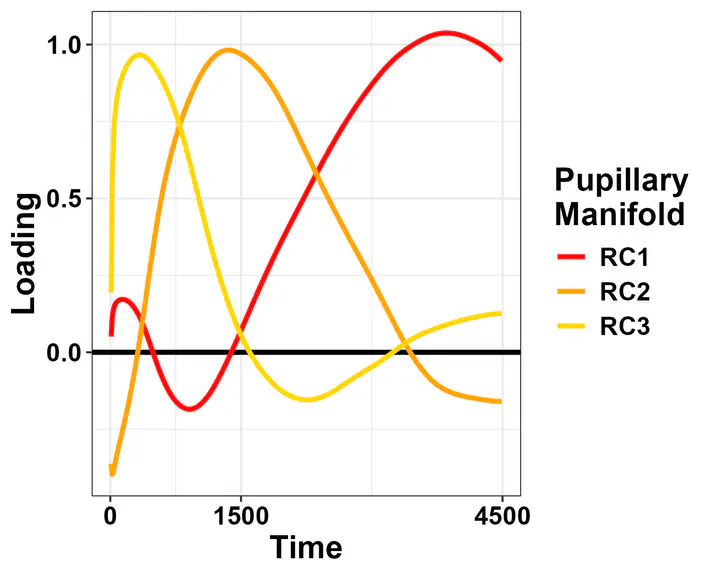
In this tutorial paper, we take a fresh look at what pupil data really tell us. Instead of focusing on when the pupil visibly changes, we suggest that the real, latent generative processes start much earlier and shape the signal before it reaches “significance”.
We describe how to leverage on dimensionality reduction techniques to uncover these processes and what we have previously described as the “pupillary manifold”. This gives us at least three big advantages:
Closer to physiology – we tap into the processes that truly drive pupil changes, dissecting the contribution of sympathetic and parasympathetic components. The underlying rationale is that analyzing pupil data as any other data, that is by disregarding the core physiological mechanisms that are at play, would be a missed opportunity.
Easier to analyze – we get clean, manageable scores for statistical models. No need for complex, difficult to interpret modelling of the trajectory of changes. Pupil size changes are strongly autocorrelated and low-dimensional anyway.
Fewer arbitrary choices – we avoid many of the common researchers’ degrees of freedom in data analysis, such as choosing temporal windows or smoothing functions. Sure enough, other arbitrary choices are introduced, but the overall tradeoff is pretty favorable.
The article takes the form of a tutorial paper for the opensource R package, Pupilla, which I am happy that can finally be nicely showcased: https://eblini.github.io/Pupilla/
This work also lays the important foundation of BEST-VS, in which we will try to uncover the electrophysiological correlates of these core biological processes.
The article can be found at the following link:
https://link.springer.com/article/10.3758/s13428-025-02786-0
Abstract
The measurement of pupil size is a classic tool in psychophysiology, but its popularity has recently surged due to the rapid developments of the eye-tracking industry. Concurrently, several authors have outlined a wealth of strategies for tackling pupillary recordings analytically. The consensus is that the “temporal” aspect of changes in pupil size is key, and that the analytical approach should be mindful of the temporal factor. Here we take a more radical stance on the matter by suggesting that, by the time significant changes in pupil size are detected, it is already too late. We suggest that these changes are indeed the result of distinct, core physiological processes that originate several hundreds of milliseconds before that moment and altogether shape the observed signal. These processes can be recovered indirectly by leveraging dimensionality reduction techniques. Here we therefore outline key concepts of temporal principal components analysis and related rotations to show that they reveal a latent, lowdimensional space that represents these processes very efficiently: a pupillary manifold. We elaborate on why assessing the pupillary manifold provides an alternative, appealing analytical solution for data analysis. In particular, dimensionality reduction returns scores that are (1) mindful of the relevant physiology underlying the observed changes in pupil size, (2) extremely handy and manageable for statistical modelling, and (3) devoid of several arbitrary choices. We elaborate on these points in the form of a tutorial paper for the functions provided in the accompanying R library “Pupilla.”

Elvio A. Blini
Assistant Professor of General Psychology
Italian cognitive (neuro)scientist. Taciturn.